Most of us are comfortable talking about a cough or a headache. Bowel habits are a different story. People put off the conversation for weeks, sometimes months, out of embarrassment or the hope that it will “settle on its own.”
In my practice as a surgical oncologist, I see how much that delay costs. Colorectal cancer, which includes cancer of the colon and the rectum, is one of the most treatable cancers when it is found early. It becomes much harder to treat when it is found late. The difference often comes down to whether a person acted on a small change in time.
What is colorectal cancer?
Colorectal cancer begins in the large intestine (colon) or the rectum. Most cases start as small, harmless growths called polyps on the inner lining of the bowel. Not every polyp turns into cancer, but some do, and the change usually takes years. That long window is exactly why screening works so well. A polyp removed today cannot become cancer tomorrow.
Symptoms of colorectal cancer
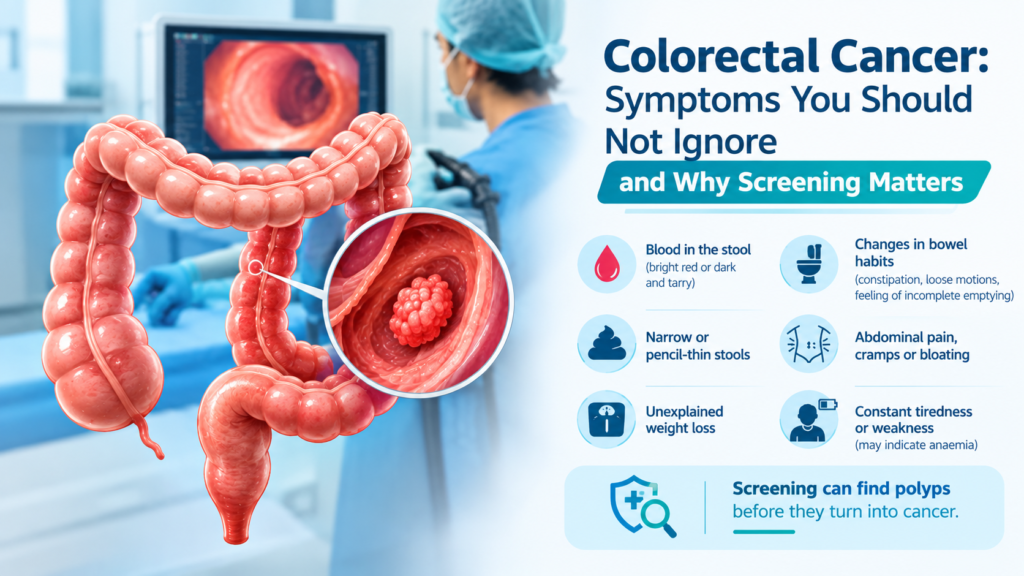
Early colorectal cancer often causes no symptoms at all. When symptoms do appear, they are easy to mistake for piles, acidity or a stomach infection. Watch for these:
- Blood in the stool. It may be bright red or dark and tarry. Many people assume it is piles, but you should never decide that on your own.
- A lasting change in bowel habits. New constipation, loose motions, or a feeling that your bowel never empties fully, lasting more than two to three weeks.
- Narrow or pencil-thin stools.
- Abdominal pain, cramps or bloating that keeps returning without a clear reason.
- Unexplained weight loss.
- Constant tiredness or weakness. Slow bleeding inside the bowel can cause anaemia, which shows up as fatigue, breathlessness or a pale face.
One of these on a single day is rarely a worry. The same symptom lasting for weeks is a reason to see a doctor. For a wider look at warning signs across cancers, you can also read our guide on signs and symptoms of cancer.
Who is at higher risk?
Anyone can develop colorectal cancer, but some factors raise the risk:
- Age above 45 to 50
- A family history of colorectal cancer or polyps
- Inflammatory bowel disease such as ulcerative colitis or Crohn’s disease
- A diet low in fibre and high in processed or red meat
- Obesity, low physical activity, smoking and heavy alcohol use
- Certain inherited conditions, such as Lynch syndrome
There is also a trend that worries doctors everywhere. Colorectal cancer is being seen more often in people under 50. If you are young and have persistent symptoms, please do not assume “it can’t be cancer at my age.” We have discussed this shift in more detail inwhy cancer is increasing in young adults.
Screening: finding cancer before it causes symptoms
Screening means testing healthy people with no symptoms. For colorectal cancer, the common options are:
- Colonoscopy. A thin, flexible camera examines the whole bowel. Polyps can be removed during the same procedure. It is considered the most complete test.
- Stool-based tests. These check for hidden blood or abnormal DNA in a stool sample.
- CT colonography. An imaging option for people who cannot or prefer not to have a colonoscopy.
Most guidelines suggest starting screening around age 45 to 50 for people at average risk. If a parent, brother or sister has had colorectal cancer, screening usually should begin earlier, often at 40 or ten years before the age at which the relative was diagnosed. Your doctor can plan the right schedule for you.
How is colorectal cancer diagnosed?
If a doctor suspects cancer, the usual steps are a colonoscopy with a biopsy, blood tests, and scans such as CT or MRI to see how far the disease has spread. A common worry is whether a biopsy can make cancer spread. It cannot, and we explain this in our article on whether biopsy spreads cancer.
Treatment options
Treatment depends on the exact location, the stage, and the person’s overall health.
Surgery is the main treatment for most colon cancers. The affected part of the bowel is removed along with nearby lymph nodes, and the healthy ends are joined back together. Where possible, this is done with laparoscopic (keyhole) surgery, which means smaller cuts, less pain, a shorter hospital stay and a quicker return to normal life. Our laparoscopic cancer surgery recovery guide explains what to expect afterwards.
Rectal cancer often needs a combined approach. Radiation and chemotherapy may be given before surgery to shrink the tumour, and the surgery itself is planned carefully to protect bowel and bladder function wherever possible.
Chemotherapy may be advised after surgery if cancer has reached the lymph nodes, to lower the chance of it coming back. You can read about managing the side effects of cancer treatment if you or someone close to you is going through it.
Targeted therapy and immunotherapy are used in selected cases, often guided by tests on the tumour itself.
Habits that help lower your risk
You cannot control age or genes, but daily habits do make a difference:
- Eat more vegetables, fruit, whole grains and pulses. Cut back on processed and charred meat.
- Stay active. Even a brisk 30-minute walk most days helps.
- Keep your weight in a healthy range.
- Avoid tobacco and limit alcohol.
- Do not skip screening once you reach the recommended age.
When should you see a doctor?
Please consult a doctor promptly if you notice blood in your stool, a bowel habit change lasting more than a few weeks, ongoing abdominal pain, or weight loss you cannot explain. Early evaluation is simple, and in most people the cause turns out to be something less serious. But if it is cancer, those early weeks matter enormously.
If you are looking for expert guidance, here is how to choose the best surgical oncologist in Lucknow.
Final thoughts
Colorectal cancer is common, but it is also one of the few cancers we can often prevent and, when caught early, very often cure. Listening to your body and getting screened on time are the two most powerful things you can do.
Dr Shashank Chaudhary is a Surgical Oncologist in Lucknow, with expertise in laparoscopic cancer surgery, gastrointestinal and hepatopancreatobiliary oncology, head and neck, breast, gynecologic, thoracic, uro-oncology and musculoskeletal oncology. To book a consultation, visit drshashankchaudhary.com.
This article is for general awareness and does not replace a personal medical consultation.
Frequently Asked Questions
What are the first signs of colorectal cancer?
Often there aren’t any, and that’s the tricky part. When symptoms do show up, they’re usually blood in the stool, a change in bowel habits that doesn’t go away, thin pencil-like stools, belly pain or bloating that keeps coming back, weight loss you can’t explain, or tiredness that doesn’t improve with rest. If any of these hang around for more than two or three weeks, please get it checked.
I see blood in my stool. Is it just piles?
It might well be. Piles are very common, and most people who see blood do have a harmless cause. But colorectal cancer can look the same from the outside, so it isn’t something to decide on your own. A quick examination by a doctor settles it.
I’m in my 30s. Can I really get colorectal cancer?
It’s uncommon, but it does happen, and doctors are seeing it more often in younger people than before. So if you have symptoms that won’t go away, don’t talk yourself out of a check-up just because of your age.
When should I start getting screened?
For most people at average risk, somewhere between 45 and 50. If a parent, brother or sister has had colorectal cancer, you should usually start earlier, around 40 or ten years before the age your relative was diagnosed, whichever comes first. Your doctor can work out the right timing for your family history.
What tests are used for screening?
There are three main ones. A colonoscopy uses a thin camera to look at the whole bowel, and any polyps can be removed right then. Stool tests look for hidden blood or abnormal DNA in a small sample. CT colonography is an imaging option for people who can’t or don’t want to have a colonoscopy. Colonoscopy is the most complete of the three.
How can a screening test prevent cancer and not just find it?
Most of these cancers begin as small polyps, and it usually takes years for a polyp to turn into cancer. If we find and remove it during that window, the cancer never gets the chance to form. That’s what makes this different from most other cancers.
Who is more likely to get it?
Risk goes up with age, a family history of colorectal cancer or polyps, and conditions like ulcerative colitis, Crohn’s disease or Lynch syndrome. Lifestyle plays a part too: a diet low in fibre and heavy on red or processed meat, obesity, little exercise, smoking and a lot of alcohol.
How is it diagnosed?
Usually with a colonoscopy, during which a small piece of tissue (a biopsy) is taken. Blood tests and scans like CT or MRI then show whether the disease has spread. And no, a biopsy doesn’t cause cancer to spread, which is a very common worry.
What does treatment involve?
It depends on where the cancer is, how far it has progressed and how healthy you are otherwise. For most colon cancers, surgery is the main treatment, and it can often be done with keyhole surgery, which means smaller cuts and a faster recovery. Rectal cancer may need radiation and chemotherapy first to shrink the tumour. Chemotherapy after surgery is sometimes advised if the lymph nodes are involved, and targeted therapy or immunotherapy is used in some cases.
Can colorectal cancer be cured?
Very often, yes, especially when it’s caught early. The earlier we find it, the better the outcome, and that’s the whole reason I keep talking about screening and not ignoring symptoms.
Can I lower my risk with diet and lifestyle?
You can certainly help your odds. Eat plenty of vegetables, fruit, whole grains and pulses, and go easy on processed and charred meat. Walk briskly for about 30 minutes most days, keep your weight healthy, stay away from tobacco and limit alcohol. Just don’t let any of this replace screening once you reach the age for it.
When should I see a doctor?
If you notice blood in your stool, a change in bowel habits lasting more than a few weeks, belly pain that keeps returning, or weight loss with no explanation, don’t wait. Most of the time, the cause turns out to be something minor, but if it is cancer, those early weeks make a big difference.